After more than 30 years of working with churches on generosity, I’ve had a version of the same conversation hundreds of times. A pastor wants to build a genuine culture of giving. They're theologically serious, pastorally caring, and deeply committed to treating their congregation fairly. And so, almost without realizing it, they build a giving strategy around equal treatment -- the same message, the same ask, the same engagement for every giver in the room.
I understand the instinct completely. It feels right. It feels fair. And theologically, in one important sense, it is right.
But as a strategy for unlocking the generosity God has placed in your congregation, it leaves an enormous amount on the table.
Here’s where I keep going back to when I work through this with church leaders: Scripture itself doesn’t give us a one-size-fits-all theology of giving. It gives us something far more interesting.
The three most celebrated acts of giving in the New Testament -- and one from the Old -- involve completely different people, completely different amounts, and completely different outcomes. And Scripture honors all of them.
Let me show you what I mean -- and why it changes the way a church should lead its giving culture.
Three Givers. Three Completely Different Gifts.
The Widow’s Two Coins (Mark 12:41–44)
Jesus sits across from the temple treasury and watches the crowd give. The wealthy come with large amounts. Then a poor widow steps forward and drops in two small coins -- together worth a fraction of a day’s wage.
Jesus stops everything. He calls his disciples over and makes her the standard.
Why? Because she gave all she had to live on. The size was nearly nothing. The sacrifice was total. And that is what Jesus honored.
For pastors, this is the irreducible foundation of your theology of generosity: every gift matters, every giver has dignity, and God sees the heart behind the amount. This is non-negotiable.
But it isn’t the only thing Scripture says.
Mary’s Alabaster Jar (Mark 14:3–9)
Just two chapters later, Mary breaks an alabaster jar of pure spikenard -- perfume worth more than a year’s wages -- and pours it over Jesus. The disciples are outraged at the waste. Jesus defends her extravagantly and says her act will be told wherever the gospel is proclaimed.
What did that jar represent? Most scholars believe it was her dowry-- the security she had built and saved for her future, her marriage, her legacy. She didn’t give a portion of her wealth. She surrendered her future.
Different gift than the widow. Different form, different scale, different cost. Same wholehearted devotion.
King David’s Temple Gift (1 Chronicles 29:2–5)
And then there is David. Preparing for the construction of the Jerusalem temple, he leads the campaign by giving first -- from both his personal treasury and the royal treasury.
In today’s dollars, David’s gift would be in the range of $20 billion.This wasn’t ceremonial. It wasn’t symbolic. The temple could not have been built without it. David’s gift was the catalytic act that made the whole vision possible.
And Scripture celebrates his generosity with exactly the same reverence it uses for the widow who gave two coins.
WORTH NOTING
Notice what Scripture doesn’t do here: it doesn’t rank these givers. It doesn’t suggest the widow was more spiritually mature than David, or that David’s gift mattered less because it came from abundance. Each story is told on its own terms. Each giver is honored for what their gift actually was -- an act of wholehearted devotion in their particular context.
What These Three Gifts Actually Have in Common
Here is the thread that ties these stories together -- and it is not the amount:
• The widow’s gift was honored for its total sacrifice.
• Mary’s gift was honored for its worship and personal cost.
• David’s gift was honored for its catalytic scale and transformational impact.
Scripture doesn’t collapse these into a single category. It celebrates the full range -- because the full range is what God’s purposes actually require.
A church community needs all three kinds of giving. It needs the sacrificial gift of the widow. It needs the devoted, costly gift of Mary. And it needs the catalytic, high-impact gift of David. Not one of these is optional. Not one is spiritually superior.
But here is what too many churches miss: if all three kinds of giving are present in Scripture -- and all three are needed in practice -- then a single, undifferentiated engagement strategy will fail to honor all three.
The Leadership Mistake That Costs Churches the Most
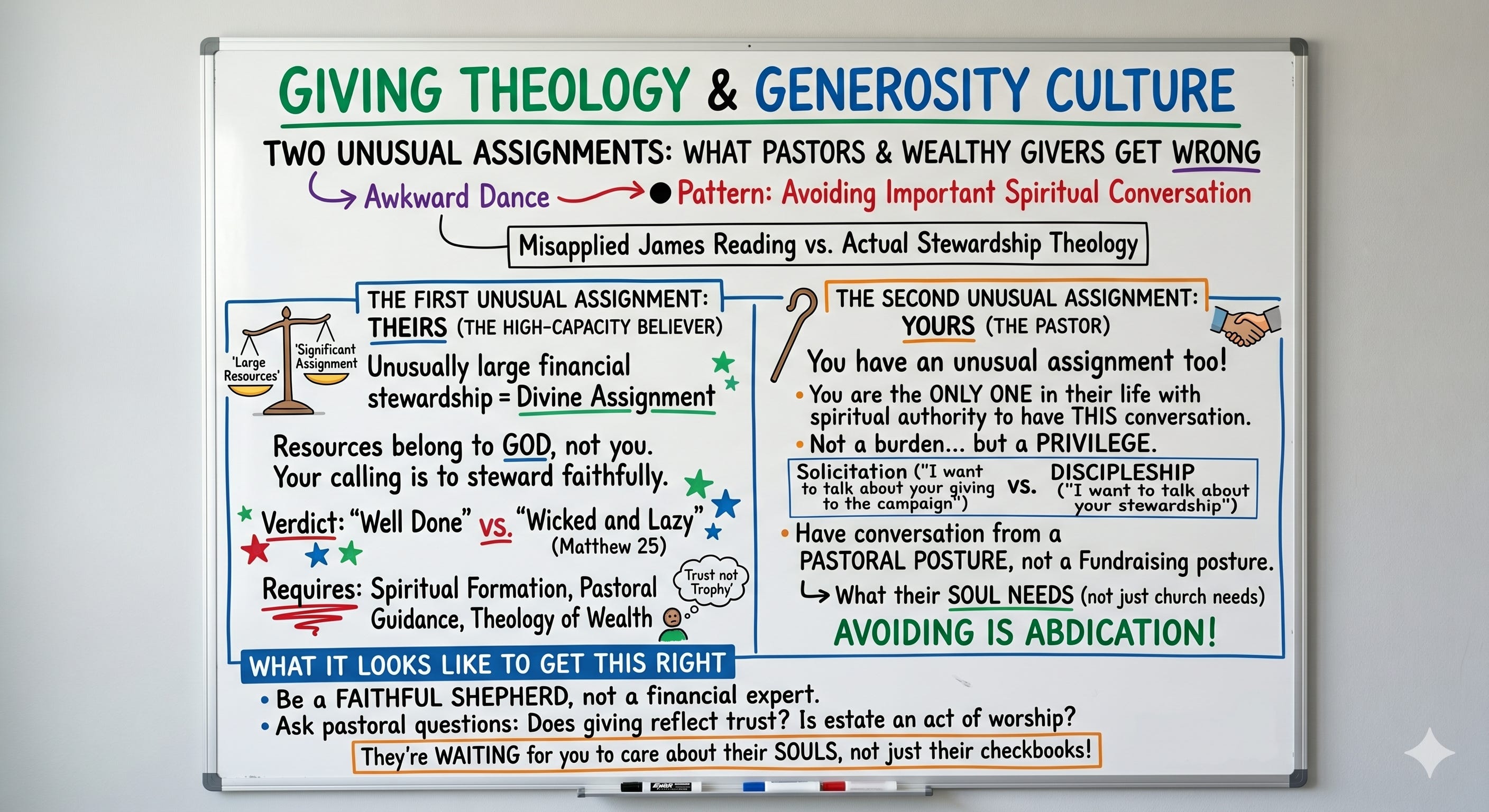
In 30 years of working with churches on generosity, the single most common and costly mistake I see is this: treating strategic differentiation as theological inequity.
It sounds like this:
“We can’t engage our major donors differently. That’s favoritism.”
I understand why it feels that way. But it conflates two distinct things: the equal dignity of every giver -- which is absolutely true and must never be compromised -- with the equal engagement of every giver, which is neither required nor wise.
Think about it from David’s perspective. If someone had told him, “We’re not going to ask you for a lead gift because that would be unfair to the widow who can only give two coins,” the temple never gets built. The vision dies not from a lack of God’s provision, but from a failure of leadership to make the right ask of the right person.
A $5,000,000 gift will fund more ministry than a $1,000 gift. That is simply true. It doesn’t make the major donor a better person or a more valued member of the congregation. But it does mean that donor needs a different kind of conversation.
In a giving initiative, in our experience, somewhere between 60 and 80 percent of the total typically comes from a small percentage of the congregation. Those givers are not more important to God. But they are more strategically important to the outcome -- and they deserve a personal, relational, vision-rich invitation that matches the scale of what you’re asking them to consider.
When you don’t give them that invitation, you’re not being fair. You’re being neglectful.
What a Differentiated Generosity Strategy Actually Looks Like
Honoring all three kinds of givers in your congregation means doing more than one thing at once.
For the congregation as a whole: a compelling, theologically grounded, pastorally warm invitation to give sacrificially at whatever level they can. The widow’s story is always relevant. Sacrifice is always the invitation.
For mid-level and emerging major givers: personal conversations that help them connect their capacity to the specific vision of the church. These are not transactions. They are discipleship conversations about what faithful stewardship looks like for someone with significant resources.
For your highest-capacity givers: a seat at the vision table. A direct, relational ask from senior leadership. An invitation to be catalytic -- to play the role that David played -- in making something possible that could not happen without them.
None of this is favoritism. All of it is stewardship.
The widow gave everything she had. Mary gave everything she had planned for. David gave at a scale that made an impossible vision possible.
Your congregation almost certainly has all three kinds of givers in it right now.
The question I keep asking senior pastors and executive pastors is not whether they believe in the equal dignity of every giver. Of course they do. The question is whether they are leading in a way that actually honors that dignity -- by giving every kind of giver the kind of invitation that matches who they actually are.
The widow deserves a pastor who calls her sacrifice beautiful and means it.
The David in your congregation deserves a pastor who looks him in the eye and says, “I believe God has positioned you to make this happen.”
Both invitations are faithful. Both are necessary. And a church that makes only one of them is not being more equitable -- it is being less effective.
You have all three kinds of givers. The question is whether you have a strategy worthy of all three.
About the Author
Jim Sheppard is the Chairman and Principal of Generis, and with more than 30 years of experience guiding leaders and congregations, he is a trusted voice in stewardship, generosity, and organizational health.
This blog post originally appeared on Church Leader Insider. For more information or to subscribe to Church Leader Insider, click HERE.

-2.png)
.png)
No Comments Yet
Let us know what you think