When the pulpit says nothing about money and the culture says everything, the culture wins by default.
Most of us have a prayer we never say out loud.
We say the other ones freely. Lord, take my schedule. Take my ambitions. Take my marriage, my parenting, my thought life, my temper. Shape me. Change me. Make me more like Jesus. And we mean it. I have spent more than thirty years among sincere followers of Christ, and I can tell you that the hunger for holiness in the church is real.
But somewhere underneath those honest prayers, there is a quieter one. It goes something like this: “I will surrender in all these areas, God. But please, not THAT.”
Not my money. Not my house. Not the retirement account, the boat, the second home, the lifestyle I have worked hard to build. Those I will manage myself, thank you.
We would never phrase it that way. We do not have to. Our bank statements phrase it for us.
The Man Who Kept Everything but One Thing
The rich young ruler is the clearest picture of this I know. He came to Jesus with genuine spiritual interest. He had kept the commandments since his youth. By every outward measure, he was the kind of person we would put on a church board.
Jesus looked at him and loved him. Mark tells us that specifically (Mark 10:21). And then Jesus went straight to the one place the young man had fenced off. “You lack one thing.” Sell what you have, give to the poor, come follow me.
He went away sad, Scripture says, because he had great possessions. More accurately, his possessions had him.
Notice that Jesus did not affirm the ninety percent and overlook the ten. He did not say, “Well done in most areas.” He went to the “not THAT.” He always does.
The area we protect most fiercely is usually the area where another god is sitting on the throne.
Mammon Is Not Neutral
This is why money is different from other areas of discipleship. Jesus did not say you cannot serve God and your calendar. He did not say you cannot serve God and your career. He said, “You cannot serve God and money” (Matthew 6:24). He gave money a name, Mammon, and set it up as a rival master. Not a tool that can be misused. A master that competes for worship.
I have written before about the two altars every believer stands between. One is the altar of God. The other is the altar of Mammon. And here is what concerns me about the culture we live in: in America, the altar of Mammon never closes. It is open 24/7/365. It is in our pockets, on our screens, in every commercial break and every scroll. It tells us we are what we own, that security comes from accumulation, and that enough is always a little more than we have.
In America, the altar of Mammon never closes. It is open 24/7/365.
When a culture builds that many shrines to a single idol, the church cannot afford to be quiet about it. Yet that is exactly what too often happens.
Why the Pulpit Goes Silent
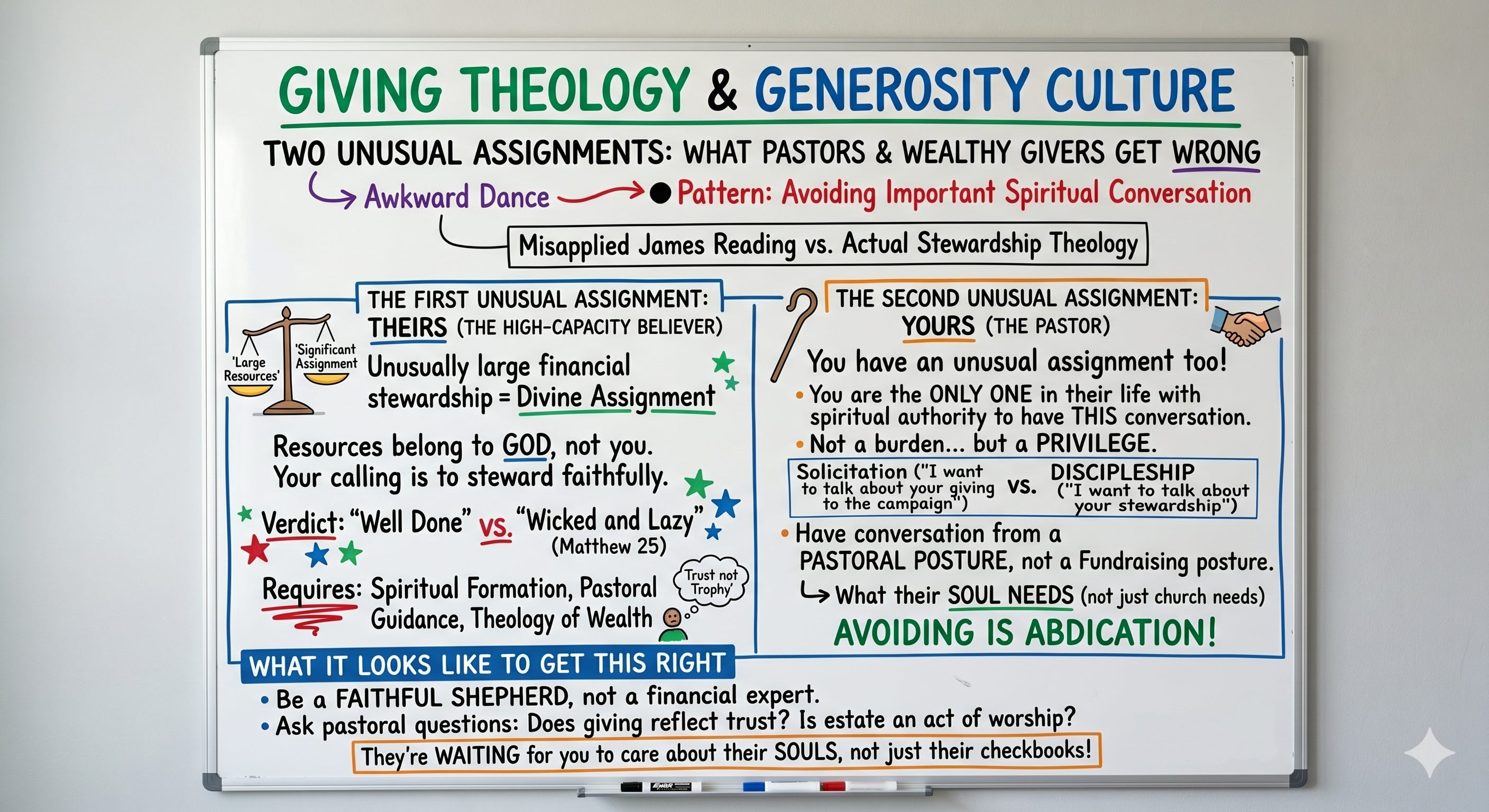
Many pastors, good and faithful pastors, avoid teaching on money. I understand why. I sit with them every week.
Some fear being lumped in with the prosperity preachers and television fundraisers who have done real damage to the witness of the church. Some worry about offending key families. Some feel a conflict of interest because their own salary comes from the offering plate. Some were never trained in seminary to teach on it. And some, if we are honest, have their own “not THAT” and do not feel qualified to call others to a surrender they have not made.
Every one of those reasons is understandable. None of them is sufficient.
Here is the fundamental misunderstanding underneath much of the silence: we have treated teaching on money and possessions as optional. A seasonal topic. Something we address once a year during the budget push, or when a capital campaign forces the issue.
Scripture does not give us that option. Jesus told us to make disciples, “teaching them to observe all that I have commanded you” (Matthew 28:20). All. Not all except the parts that make people uncomfortable. Paul declared that he had not shrunk back from proclaiming “the whole counsel of God” (Acts 20:27). And when he instructed Timothy about wealthy believers, he did not say suggest to those who are rich. He said command them not to be haughty or to set their hopes on uncertain riches, but on God, and to be rich in good works, generous and ready to share (1 Timothy 6:17-18).
That is not a fundraising instruction. It is a pastoral mandate. Discipleship in money and possessions is not an elective in the curriculum of Christian formation. It is a required course. A pastor who never teaches it is not being sensitive. He is leaving his people unprotected in the very area where their adversary is most active.
Discipleship in money and possessions is not an elective. It is a required course.
Silence is not neutral either. When the pulpit says nothing about money and the culture says everything, the culture wins by default.
Paul’s “Not THAT”
There is a beautiful irony in Philippians 4. Paul is thanking the church at Philippi for their financial support, and he stops himself to clarify his motive: “Not that I seek the gift, but I seek the fruit that increases to your credit” (Philippians 4:17).
Paul had his own “not THAT.” But it pointed in the opposite direction. He was not after their money. He was after their maturity. He understood that generosity is not what the church gets from people. It is what God does in people.
That is the posture every pastor needs when approaching this subject. We do not teach on money because the church needs it. We teach on it because our people need it. Their freedom is at stake. Their joy is at stake. Their hearts are at stake, because Jesus said plainly that where our treasure is, there our heart will be also (Matthew 6:21).
When we frame generosity as fundraising, people hear a transaction and brace themselves. When we frame it as discipleship, people hear an invitation to freedom. In my experience, they respond very differently to the second.
From “Not THAT” to “Even THAT”
So what do we do?
If you are a pastor, start by settling the question for yourself. Is this optional or mandatory? If Scripture says mandatory, then build it into your discipleship pathway the same way you would prayer, Scripture, and community. Teach it year-round, not only when the budget is tight. Disciple your high-capacity givers personally; they need a shepherd more than they need a pledge card. And go first. Your people will not walk further than you are willing to lead.
If you are a believer who has been praying around this area for years, ask yourself one honest question: Where is my “not that”? Then take one step. Not a giant leap. A step. Increase your giving by a percentage point. Give away something you have been holding too tightly. Sit down with your spouse and ask what it would look like to hold everything with an open hand.
The rich young ruler walked away sad. But I have watched hundreds of people walk the other direction, and I have never met one who regretted it. The surrender they feared turned out to be the freedom they had been missing.
God is not trying to take something from you. He is trying to give you something you cannot get any other way.
Even THAT.
About the Author
Jim Sheppard is the Chairman and Principal of Generis, and with more than 30 years of experience guiding leaders and congregations, he is a trusted voice in stewardship, generosity, and organizational health.
This blog post originally appeared on Church Leader Insider. For more information or to subscribe to Church Leader Insider, click HERE.



No Comments Yet
Let us know what you think