After more than thirty years consulting with churches, I’ve watched the same awkward dance play out again and again -- and it doesn’t have to.
Let me say something that might make a few pastors uncomfortable: the most financially resourced people in your congregation are probably the least pastored.
Not because you don’t care about them. You do.
But somewhere along the way, a combination of intimidation, misplaced theology, and fear of being misunderstood has caused many pastors to simply avoid having the most important spiritual conversation those people will ever have -- the one about what God expects them to do with an unusual amount of his money.
I’ve sat across the table from hundreds of church leaders over the past thirty-plus years, and this pattern is one of the most consistent and consequential things I’ve observed. Pastors get uncomfortable. They make it weird. They dance around the subject, qualify every word, and sometimes retreat behind a well-intentioned but misapplied reading of James that frames any individual attention to a wealthy church member as favoritism.
Let me be direct: that’s not what James is talking about.
James is warning against elevating the wealthy to positions of honor simply because of their wealth -- giving them the best seat in the house, deferring to their preferences, building your ministry around their comfort. That’s favoritism. Pastoring someone according to their actual spiritual assignment? That’s just faithfulness.
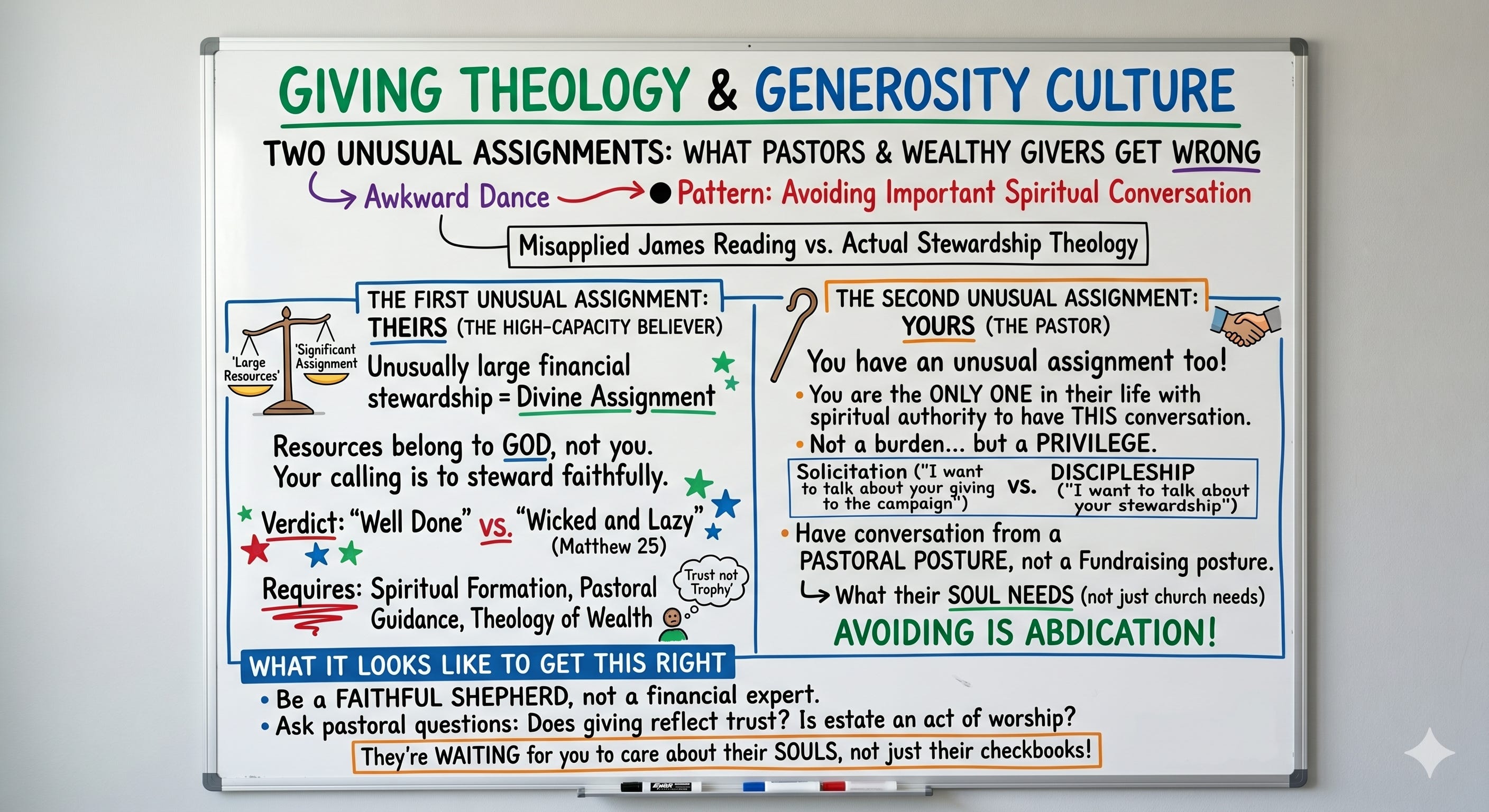
The First Unusual Assignment: Theirs
Here is a truth that I wish more wealthy believers heard clearly from a pulpit or a pastor’s office: if God has entrusted you with an unusually large amount of financial resources, you have an unusually significant assignment.
This is not flattery. It’s stewardship theology at its most serious.
“Well done, good and faithful servant” -- or -- “You wicked and lazy servant.” There is no middle ground.
Matthew 25:21, 26 · The Parable of the Talents
Jesus said as much in the Parable of the Talents (Matthew 25:14–30). The servants weren’t evaluated against each other. They were evaluated against what they’d been given. The servant entrusted with five talents was expected to produce accordingly. So is the person sitting in your congregation who quietly manages generational wealth, a successful business, or a level of liquidity most of your congregation will never know.
The haunting reality of that parable is the contrast between two verdicts. “Well done, good and faithful servant” on one side. “You wicked and lazy servant” on the other. There is no middle ground. No participation trophy for good intentions. The question the master asks is simply: what did you do with what I gave you?
Many of these high-capacity believers are genuinely trying to answer that question well. But they often lack the theological framework and the spiritual community to figure out what a faithful answer actually looks like. They have financial advisors. They may have estate attorneys. What they often don’t have is a pastor who will help them think about their resources the way God does -- as a trust, not a trophy.
ASSIGNMENT #1
The high-capacity believer
An unusually large financial stewardship is not a neutral circumstance -- it is a divine assignment. The resources under your watch belong to God. Your calling is to steward them faithfully so that when you give your account, the answer is “well done.” That requires more than generosity instincts. It requires spiritual formation, pastoral guidance, and a theology of wealth that goes deeper than tax strategy.
The Second Unusual Assignment: Yours
Pastor, here is what I want you to understand: if this person is in your church, you have been given an unusual assignment too.
You may be the only person in their life who can have this conversation.
Their financial advisor won’t raise it. Their accountant won’t raise it. Their golf partners certainly won’t. But you -- as their pastor -- have both the spiritual authority and the relational trust to help them see their resources through the lens of eternity.
That is not a burden. That is a privilege.
You may be the only person in their life positioned to have the most important spiritual conversation they’ll ever have about money.
I understand the hesitation.
Pastors tell me they don’t want to come across as transactional -- like they’re approaching a wealthy member because the church needs something. That’s a legitimate concern. But the answer to that concern isn’t to avoid the conversation. The answer is to have it from a pastoral posture rather than a fundraising posture.
There’s a real difference between “I want to talk to you about your giving to the capital campaign” and “I want to talk to you about your stewardship.”
The first is a solicitation. The second is discipleship. The first is about what your church needs. The second is about what that person’s soul needs -- and what they’ll need to say when they stand before God and give an account for everything that passed through their hands.
That conversation -- rooted not in institutional need but in genuine pastoral concern for someone’s eternal flourishing -- is exactly what most high-capacity believers have never been offered. And when a pastor has the courage to offer it, it is almost always received with gratitude, not suspicion.
ASSIGNMENT #2
The pastor
Proximity to someone with significant resources is not an accident. You are their pastor -- uniquely positioned to help them understand the spiritual weight of what’s been entrusted to them, and to walk alongside them as they seek to steward it faithfully. Avoiding the conversation isn’t humility. It’s abdication. The most loving thing you can do is engage.
What It Looks Like to Get This Right
Pastoring someone well in this area doesn’t require you to become a financial expert.
It requires you to be a faithful shepherd who asks the right questions and creates the right space.
What does it look like to be a faithful steward of this level of resource? What does your giving reflect about your trust in God’s provision? Have you thought carefully about your estate as an act of worship -- not just an act of estate planning? Are the resources under your watch aligned with the things you say matter most to you?
These are pastoral questions. They don’t require you to know anything about portfolio management. They require you to know your Bible, know your parishioner, and care enough to go there.
After more than thirty years in this work, I am convinced that most wealthy believers are not resistant to this conversation -- they’re waiting for it. They’ve been waiting for someone to care enough about their souls, not just their checkbooks, to have it with them.
That someone should be you.
About the Author
Jim Sheppard is the Chairman and Principal of Generis, and with more than 30 years of experience guiding leaders and congregations, he is a trusted voice in stewardship, generosity, and organizational health.
This blog post originally appeared on Church Leader Insider. For more information or to subscribe to Church Leader Insider, click HERE.

-2.png)
-2.png)

No Comments Yet
Let us know what you think